

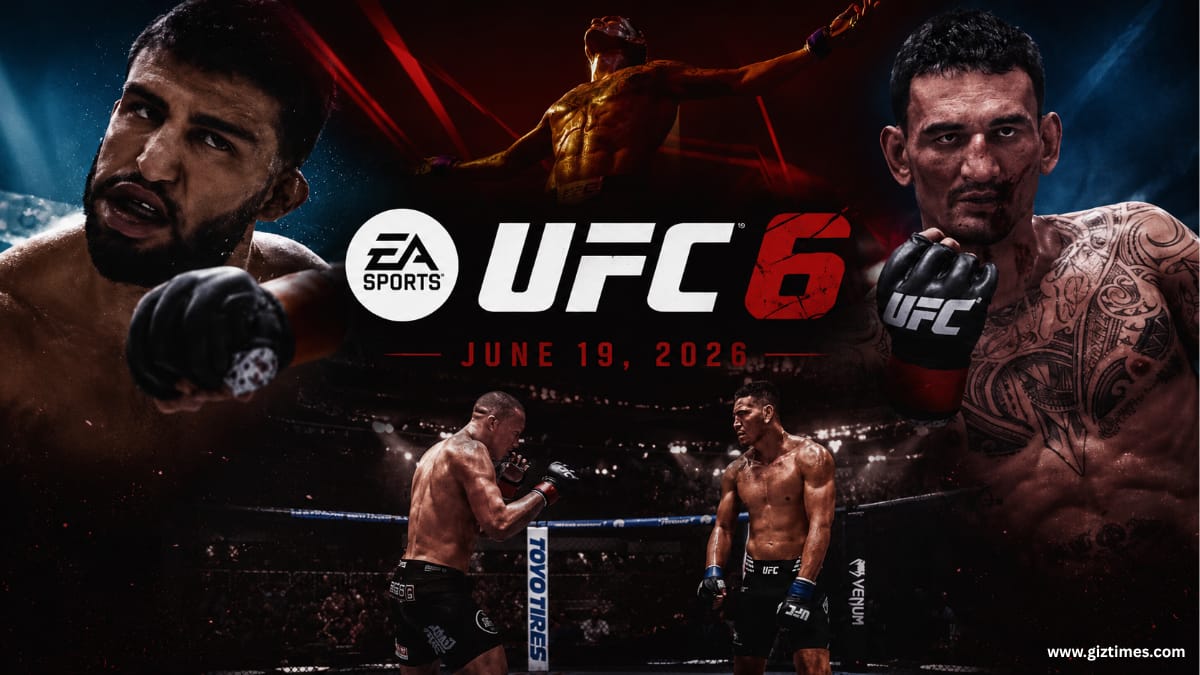
HYDERABAD, India (GizTimes) — The reveal trailer for EA Sports UFC 6 is now live on YouTube, and EA is positioning this entry as the franchise’s biggest gameplay overhaul since the transition to Frostbite. Launching June 19, 2026 for PlayStation 5 and Xbox Series X|S, UFC 6 pushes heavily toward realism, tactical pacing, and fighter individuality instead of the faster arcade rhythm that defined criticism around previous EA UFC titles.
Built exclusively for current-generation hardware, UFC 6 introduces new systems focused on real-time combat reactions, momentum management, signature fighter behavior, and cinematic presentation. Former UFC champions Alex Pereira and Max Holloway headline the marketing campaign, while the reveal trailer emphasizes knockouts, fantasy matchups, and upgraded facial animation technology.
The tension surrounding UFC 6 is clear. EA is promising meaningful gameplay evolution after UFC 5 received criticism for feeling too similar to UFC 4 despite major visual improvements. This time, the publisher is framing UFC 6 as a systems-driven simulation upgrade rather than a graphical refresh.
Why This Matters in Gameplay
The biggest difference between UFC 6 and UFC 5 is philosophical. UFC 5 focused heavily on visual authenticity through the Frostbite engine and damage presentation. UFC 6 shifts toward gameplay identity.
The new Markerless Capture system, Sapien Technology, and advanced motion systems are designed to stop fighters from feeling mechanically identical. According to EA, fighters now have unique striking rhythms, defensive tendencies, momentum systems, and weaknesses. Early beta impressions suggest the game rewards fighting in character instead of using universal exploit-heavy playstyles.
That matters because one of the long-running complaints in EA’s UFC franchise has been homogenized combat. In previous games, elite strikers, pressure fighters, and technical counter punchers often shared similar animation timing and offensive flow. UFC 6 appears built specifically to reduce that problem.
The new Flow State mechanic reinforces this direction. Momentum now builds differently depending on how a fighter naturally performs. Aggressive pressure fighters gain advantages differently from patient technical strikers, and mistakes reportedly carry heavier punishment. Community feedback also points toward slower pacing and faster knockouts, which changes match psychology significantly.
This creates a more simulation-focused structure where patience, timing, and fighter selection matter more than pure combo speed. It also suggests EA is targeting hardcore MMA fans who wanted less arcade chaos and more authentic octagon pacing.
Framework Integration
UFC 6 is clearly evolving systems first introduced in EA Sports UFC 5, particularly Frostbite physics and cinematic damage presentation. UFC 5 introduced the Real Impact System, doctor stoppages, smoother grappling transitions, and realistic replay technology. UFC 6 expands that foundation into real-time contact simulation.
The new Real-Time Contact system replaces more scripted interactions with dynamic impact reactions, improved ragdoll behavior, and fairer collision detection. EA claims punches, kicks, knockdowns, and body impacts now react contextually instead of triggering canned animation sequences.
This is important because UFC 5’s largest criticism was not graphical quality. It was gameplay repetition. Many players believed UFC 5 looked next-generation but still felt structurally tied to UFC 4 underneath the visuals.
UFC 6 appears to directly respond to that criticism.
The slower pacing reported in beta discussions is another major shift. UFC 5 often rewarded aggressive volume striking and pressure-heavy gameplay loops. UFC 6’s heavier punishment system and tactical rhythm could reduce spam-heavy online metas that frustrated competitive players.
At the same time, several unresolved concerns remain.
The lack of extended gameplay footage before launch has created skepticism among longtime fans. EA is heavily marketing realism and fighter individuality, but players still fear reused animation assets from UFC 5. That concern matters because the franchise has historically struggled to convince players that yearly or iterative upgrades justify full-price releases.
The continued absence of a PC version also weakens UFC 6’s market reach. While EA is positioning the game as a premium current-generation simulation title, PC remains one of the largest competitive and streaming ecosystems for sports and fighting games. The lack of PC support limits modding communities, esports expansion potential, and broader accessibility.
There is also a subtle contradiction in EA’s strategy. UFC 6 markets itself around authenticity and realism while simultaneously expanding live-service monetization through fighter skins, progression boosts, expansion passes, cosmetics, and virtual currency systems. That creates tension between competitive fairness and long-term monetization design.
Comparison
UFC 6 does not look like a full reboot of the franchise. Structurally, it is an aggressive refinement of UFC 5’s Frostbite framework. The difference is that UFC 6 prioritizes gameplay behavior and physical interaction rather than presentation alone.
| Feature | UFC 5 | UFC 6 |
|---|---|---|
| Release Date | October 27, 2023 | June 19, 2026 |
| Engine | Frostbite | Frostbite |
| Platforms | PS5, Xbox Series X|S | PS5, Xbox Series X|S |
| PC Version | No | No announced PC version |
| Core Focus | Visual realism and damage systems | Fighter individuality and tactical realism |
| Headline System | Real Impact System | Real-Time Contact System |
| Gameplay Philosophy | Cinematic MMA presentation | Simulation-focused combat identity |
| Knockout Presentation | Cinematic replay upgrades | Dynamic physics-driven impact reactions |
| Career Focus | Traditional progression | Narrative-driven “The Legacy” mode |
| Live-Service Structure | Fight Week events | Expansion Pass + VIP ecosystem |
| Cover Athletes | Alexander Volkanovski, Valentina Shevchenko | Alex Pereira, Max Holloway |
| Major Community Criticism | Reused gameplay feel | Fear of reused UFC 5 assets |
| Technical Enhancements | Frostbite transition | PS5 Pro support, PSSR2, ray-traced AO |
One non-obvious pattern emerging from the available information is that UFC 6 is less focused on graphical leap and more focused on gameplay readability. Faster knockouts, heavier punishment systems, and distinct fighter rhythms all point toward matches becoming easier to visually understand for both players and spectators. That could improve streaming and esports watchability even without a formal competitive overhaul.
Public Reaction Analysis
Early community reactions show cautious optimism rather than pure hype.
Players praising the beta impressions consistently focus on combat feel instead of graphics. Comments about heavier strike impact, tactical pacing, and fighter uniqueness suggest the audience specifically wanted gameplay differentiation after UFC 5’s criticism.
At the same time, skepticism remains deeply tied to EA’s reputation with sports franchises. Concerns about reused animations and missing gameplay footage reveal a trust issue more than a visual issue. Players are no longer judging UFC games purely on trailers. They want proof that the systems underneath the visuals have genuinely evolved.

The reaction to Conor McGregor appearing prominently in marketing despite long inactivity also highlights EA’s commercial balancing act. The company is clearly leaning into recognizable UFC star power and nostalgia to maximize trailer engagement, even while promoting realism and authenticity.

Another interesting divide appears around grappling. One player praised the graphics but criticized grappling itself as a gameplay concept that “doesn’t really work for a video game.” That reflects a long-running design challenge for MMA titles. Realistic grappling is mechanically slower and strategically layered, but mainstream players often prefer striking-focused action. UFC 6’s slower tactical direction could deepen that divide between hardcore simulation fans and casual players.

Career mode expectations also remain extremely high. Requests for social systems, rivals, and unique cutscenes show that many players now view career immersion as equally important as combat mechanics. EA’s new “The Legacy” mode appears designed to answer those demands directly.
Why It Matters
UFC 6 represents a critical moment for EA’s MMA franchise because the broader sports gaming market is shifting toward authenticity-driven retention instead of pure annual iteration.
Modern players expect simulation games to create identity-based gameplay systems rather than simple animation upgrades. That is visible across sports titles, fighting games, and live-service ecosystems. UFC 6’s focus on fighter individuality, tactical pacing, and dynamic physical interactions aligns with that trend.
The game’s success will likely depend on whether those systems genuinely change match behavior over long-term play. If the momentum systems, real-time collisions, and individualized fighters work consistently online, UFC 6 could finally separate itself mechanically from UFC 4 and UFC 5.
But EA is also entering a more demanding era for live-service sports games. Players are increasingly skeptical of monetization-heavy ecosystems without meaningful gameplay evolution. UFC 6’s expansion passes, cosmetics, and progression systems will face heavy scrutiny if the gameplay improvements fail to feel transformative.
The lack of a PC version remains another strategic limitation. Fighting and sports communities increasingly rely on streaming ecosystems, mods, competitive infrastructure, and creator-driven visibility. Remaining console-exclusive narrows UFC 6’s long-term ecosystem potential despite its technical ambitions.
Extra Takeaways
The Hall of Legends mode quietly reveals another important strategy shift. EA appears to be leaning harder into UFC history and nostalgia as part of long-term engagement design. Fantasy matchups, legendary careers, and iconic moments create content flexibility that extends beyond active UFC rosters.
PS5 Pro support also signals that EA wants UFC 6 positioned as a technical showcase for console combat sports gaming. Features like ray-traced ambient occlusion, PSSR2 upscaling, and enhanced replay fidelity suggest visual presentation remains central to the franchise identity even while gameplay systems take priority.
The reveal trailer’s emphasis on cinematic knockouts and facial reactions also shows EA understands shareability culture. High-impact KO clips remain one of the UFC franchise’s strongest social media strengths.
If successful, UFC 6 could redefine EA’s MMA franchise as a true simulation-focused combat platform, but lingering skepticism around gameplay transparency and missing PC support could still limit its long-term momentum.
