


ANUPPUR, India (GizTimes) — Epic Games did not announce Unreal Engine 6 at a developer conference. It unveiled the engine during the Rocket League Championship Series Paris Major, placing foundational middleware technology in front of esports fans rather than rendering engineers. That decision matters because it reframes Unreal Engine from a development tool into a consumer-facing ecosystem brand.
The announcement confirmed Rocket League’s migration from an 11-year-old Unreal Engine 3 foundation directly to Unreal Engine 6, bypassing the long-expected UE5 transition. The move signals something larger than graphical upgrades: Epic appears to be positioning UE6 as infrastructure for persistent digital economies, interoperable content, and cross-title ecosystems.
The tension is clear. Epic is selling a future built around integration and persistence while developers and players are still debating whether Unreal Engine 5’s stuttering and optimization issues were ever fully solved.
Why This Matters in Gameplay
Rocket League is one of the worst possible games for an engine migration because its competitive identity depends on deterministic physics. Tiny differences in ball collision, momentum transfer, or vehicle handling could change years of player muscle memory. Professional players effectively train around millisecond timing and microscopic spatial consistency.
Epic therefore faces two conflicting objectives:
- Maintain exact mechanical feel.
- Deliver visual upgrades, networking improvements, new content systems, and broader ecosystem integration.
- If either fails, Rocket League becomes a case study against large-scale engine transitions.
The reveal trailer emphasized:
- Real-time lighting upgrades
- Advanced particle systems
- Improved reflections and materials
- Dense environmental effects
- Enhanced destruction visuals
- Dynamic weather and volumetric lighting
Yet visuals are secondary. The more important promise is backend optimization targeting shader compilation delays, frame pacing problems, and rendering inefficiencies associated with UE5 deployments.
That indicates Epic may be competing less on raw fidelity and more on performance reliability.
Top Issues on Previous Version
Issue 1: UE5’s Reputation Problem Remains Unresolved
Community skepticism follows UE6 because Unreal Engine 5 gained criticism for traversal stuttering, optimization failures, and shader compilation bottlenecks. Developers often had to perform extensive optimization work to avoid unstable experiences.
The biggest challenge for UE6 is perception.
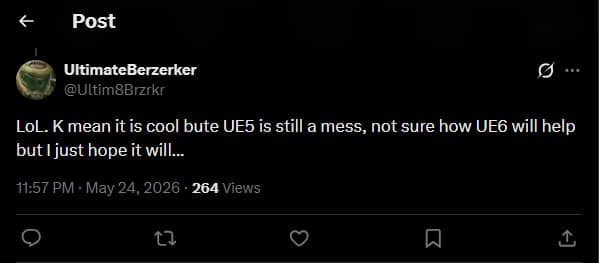
Players are already asking: “UE5 is still a mess, not sure how UE6 will help.”
That reaction reflects trust erosion rather than resistance to innovation.
Issue 2: Physics Preservation Could Define UE6’s Success
Rocket League cannot tolerate meaningful changes in gameplay feel.
The requirement is unusual: rewrite infrastructure while preserving decade-old mechanics with near-perfect fidelity.
This may become UE6’s first public stress test.
Issue 3: Unreal Engine 6 Risks Arriving Before UE5 Maturity
Some community reactions question whether developers have even exhausted UE5 capabilities:
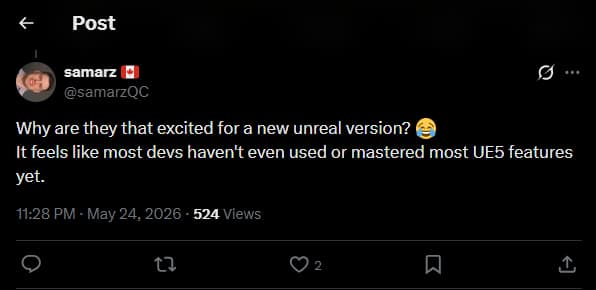
“Most devs haven’t even used or mastered most UE5 features yet.”
That criticism introduces a broader industry concern:
Are engine generations accelerating faster than studios can adapt? If true, smaller teams may face increasing technological debt.
Issue 4: The Engine Is Becoming an Ecosystem Strategy
Epic’s long-term vision combines:
- UE5 rendering systems
- Fortnite development tools
- Verse programming language
- Cross-title asset portability
- Persistent social infrastructure
The non-obvious implication is that UE6 may compete less against Unity or Godot on rendering and more against platform ecosystems themselves.
The target increasingly looks like ownership of digital economies.
Comparison Between Unreal Engine 5 and Unreal Engine 6
UE6 appears positioned as a corrective generation rather than a revolutionary graphics leap. The transition emphasizes infrastructure efficiency, interoperability, and ecosystem integration.
| Category | Unreal Engine 5 | Unreal Engine 6 |
|---|---|---|
| Core Strength | Nanite + Lumen | UE5 rendering + Verse integration |
| Main Criticism | Shader stutter, optimization issues | Unproven, concerns inherited from UE5 |
| Strategic Goal | Visual fidelity | Unified ecosystem and persistent networking |
| Market Position | Graphics leader | Infrastructure + ecosystem platform |
| Rocket League Status | Expected migration never arrived | Confirmed transition path |
| Optimization Focus | Developer dependent | Native remediation of compilation delays |
Data derived from uploaded materials only.
Hardware Requirements: What UE6 May Demand
The uploaded hardware estimates suggest a steep escalation in computing requirements. These figures are presented as compiled expectations based on available developer information rather than confirmed public specifications.
| Resolution Target | CPU | GPU Requirement |
|---|---|---|
| Full HD | AMD Ryzen 7 9800X3D | RTX 5080 / Radeon RX 9070 XT |
| 2K | — | RTX 5090 / Radeon RX 10800 XT |
| 4K | — | Future RTX 6090 |
One interpretation is worrying:
If these projections approach reality, UE6 could intensify hardware stratification where premium experiences become increasingly dependent on flagship GPUs. That would create friction between Epic’s vision of mass ecosystem participation and practical accessibility.
Public Reaction On Announcement
The reactions reveal three psychological camps.
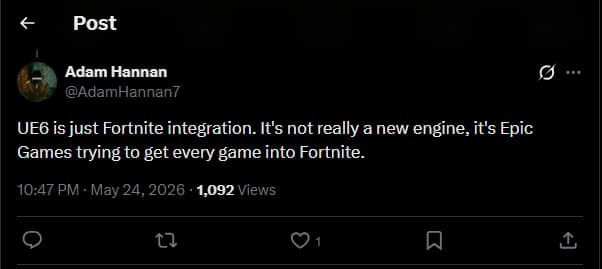
The first sees UE6 as ecosystem consolidation: “UE6 is just Fortnite integration.”
That suggests concern that Epic’s interoperability goals reduce engine evolution into platform centralization.
The second group is skeptical because UE5 performance frustrations remain unresolved.
The third questions timing, arguing developers have not fully mastered UE5.
Together these reactions show something important:
The market no longer evaluates new engines mainly through graphical promises. Stability, longevity, and adoption friction increasingly matter more.
That is a significant shift in expectations.
Why It Matters
Epic is trying to turn engine technology into infrastructure governing development tools, digital ownership, content creation, and distribution economics simultaneously. Its royalty adjustments and ecosystem incentives reinforce that strategy.
Success would strengthen Epic’s influence across engines, storefronts, and live-service ecosystems.
Failure would reinforce industry skepticism toward increasingly ambitious metaverse-oriented frameworks.
Rocket League becomes the proving ground.
Extra Insights
The most revealing part of the announcement may not be Unreal Engine 6 itself.
It is where Epic announced it.
Launching at RLCS instead of a technical conference implies Epic increasingly believes competitive players and creators are stakeholders in engine evolution. Middleware is being marketed like entertainment.
That is unusual—and potentially transformative.
If successful, Unreal Engine 6 could redefine digital ecosystems by merging performance, interoperability, and persistent economies, but unresolved optimization concerns and competitive integrity risks may determine whether developers and players trust the transition.
Read More:
- Galaxy Watch8 and Pixel Watch 4 Represent Two Completely Different Futures of Smartwatches
- BMW M440i vs Porsche 911 Carrera Cabriolet: Why BMW’s Formula Targets a Wider Performance Audience
- Project Glasswing New Update Signals a Bigger Shift: Cybersecurity Is Becoming an AI-Driven Continuous Defense System
