

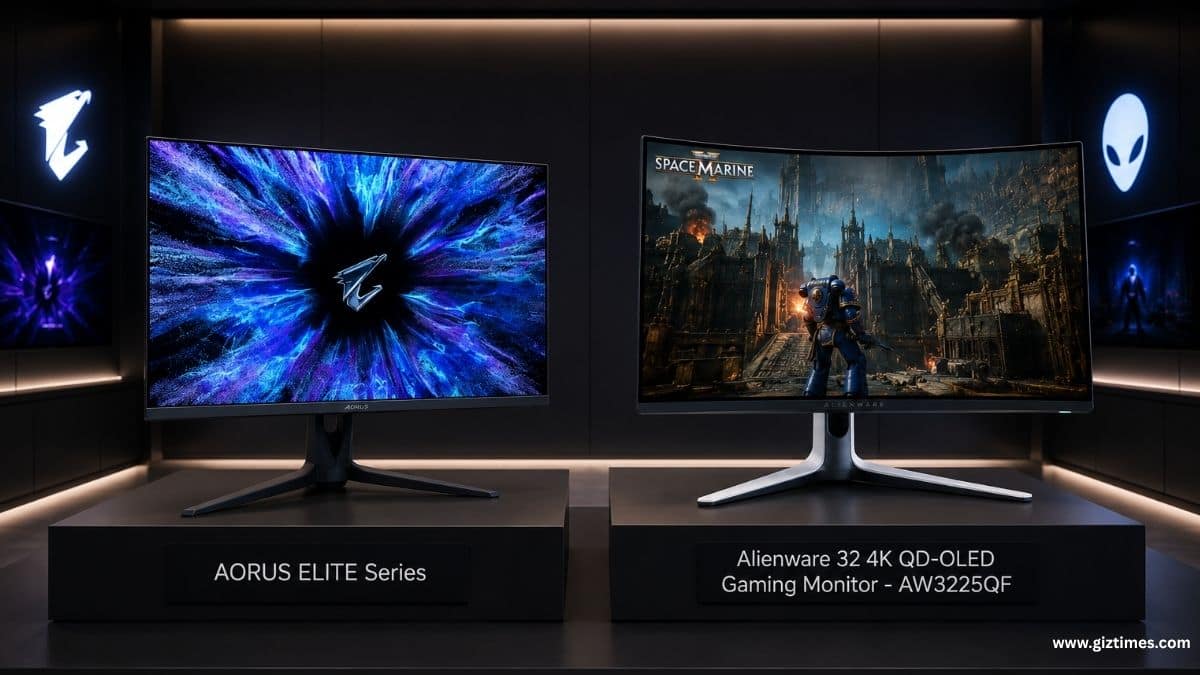
HYDERABAD, India (GizTimes) —The premium gaming monitor market is no longer fighting over resolution alone. The real battle in 2026 is about adaptability. One company is building displays that can transform depending on the workload, while another is refining a single visual experience until it feels almost cinematic.
GIGABYTE’s new AORUS ELITE series arrives with an unusually aggressive thesis: one monitor should replace multiple displays. Its lineup combines Multi-Mode refresh-rate switching, 5K Mini LED configurations, 80Gbps DisplayPort 2.1 connectivity, and AI-driven image processing aimed at both esports and productivity users.
Dell’s Alienware AW3225QF takes the opposite route. Instead of versatility, it doubles down on immersion through a curved 32-inch 4K QD-OLED panel tuned for contrast depth, color volume, and cinematic presentation.
The result is a comparison that goes beyond OLED versus Mini LED. This is really about whether buyers should prioritize adaptable long-term utility or the most visually immersive gaming experience available today.
Why These Displays Exist
The AORUS ELITE lineup exists because the traditional enthusiast setup stopped making sense. Competitive gamers often needed a second high-refresh monitor beside their 4K display. Productivity users worried about OLED burn-in during static desktop use. Creators wanted Retina-level sharpness without giving up gaming responsiveness. GIGABYTE is clearly targeting all three groups simultaneously.
That explains why the FM275K16P can switch between 5K at 180Hz, 4K at 220Hz, and QHD at 330Hz using hardware-level Multi-Mode processing. The monitor is effectively trying to become three different displays without forcing the user into software scaling compromises.
Alienware’s AW3225QF is built around a much narrower but cleaner vision. Dell is chasing emotional immersion rather than functional flexibility. The 1700R curve, glossy QD-OLED coating, Dolby Vision support, and deep contrast tuning are all optimized for cinematic gaming and entertainment in controlled lighting environments.
That difference becomes obvious when you look at what each company sacrificed. GIGABYTE intentionally limits USB-C power delivery to 15W because reducing thermal stress matters more for OLED longevity than laptop docking convenience. Dell skips KVM switching entirely because the AW3225QF is designed primarily as a dedicated gaming centerpiece rather than a workstation hub. Neither decision is accidental.
The Real Longevity Advantage Is Not OLED vs Mini LED
The obvious conversation here is burn-in. The more important conversation is how these companies are engineering around it.
Alienware’s QD-OLED panel still relies heavily on active cooling and aggressive brightness management. The monitor uses fan-assisted thermal control and deliberately dims high-APL HDR scenes through strict EOTF roll-off behavior to comply with Samsung’s power-control limitations. That means the display protects itself by reducing brightness during sustained bright scenes.
GIGABYTE approaches the problem differently. Its Tandem WOLED architecture physically distributes electrical load across two OLED emission layers, reducing thermal concentration while simultaneously increasing brightness ceilings to 1,500 nits. Instead of relying primarily on aggressive brightness suppression, the hardware itself is engineered to run cooler under load.
That distinction matters long term. The AORUS lineup also layers multiple AI-based protection systems over the hardware foundation, including Pixel Shift, Static Control, Sub-logo Dim, APL Stabilize, and presence-detection auto-lock systems. More importantly, these protections specifically target desktop productivity behavior static taskbars, idle windows, bright office documents, and HUD elements.
That makes the AORUS monitors fundamentally safer for mixed-use ownership. The Alienware AW3225QF remains excellent for gaming-first users, but it still behaves like a display that wants to avoid static desktop abuse. The AORUS lineup behaves like hardware that expects it.
AI Processing Is Becoming the New Display Processor Race
One of the less obvious shifts in these launches is that monitors are quietly becoming processing devices.
The FM275K16P includes local AI Super Resolution hardware that performs display-level upscaling and image enhancement independently of the GPU. This is not the same as DLSS or FSR. The monitor itself is analyzing incoming image data and improving sharpness post-render.
That changes how longevity works. Historically, displays aged poorly because GPU standards evolved faster than monitor capabilities. GIGABYTE is trying to slow that aging process by embedding intelligence directly into the monitor pipeline. Lower-resolution content, legacy applications, and future performance compromises become easier to tolerate if the display itself contributes to image reconstruction.
Alienware’s AW3225QF is more traditional here. Dell focused heavily on firmware refinement, HDR correction, Dolby Vision handling, and latency optimization rather than AI-assisted processing. The result is a cleaner enthusiast display experience today, but arguably less hardware adaptability over time.
This creates a subtle but important market divide. Alienware optimizes for present-day image quality. AORUS optimizes for future flexibility.
The Curve Is Both Alienware’s Biggest Strength and Biggest Limitation
The AW3225QF’s 1700R curvature is what makes the monitor memorable. It enhances peripheral immersion and creates a stronger cinematic wraparound effect during gaming. But the curve also locks the display into a specific type of ownership.
Curved panels are fantastic for single-user entertainment. They are less ideal for productivity layouts, geometric accuracy, shared viewing, and multi-window desktop workflows. Straight lines can visually distort in CAD work, spreadsheets, and design applications.
GIGABYTE’s flat-panel strategy feels more practical for broader ownership. This becomes especially relevant when paired with the 5K 218 PPI Mini LED model. At Retina-class density, the FM275K16P is positioned as both a creator monitor and a competitive gaming display simultaneously. Alienware’s 140 PPI 4K OLED still looks excellent, but it is fundamentally optimized around entertainment immersion first.
That is the non-obvious divide in this comparison.
The AW3225QF is arguably the more emotionally impressive monitor. The AORUS ELITE lineup is the more adaptable ownership decision.
Comparison
The two products are approaching the premium gaming monitor market from completely different philosophical directions. Alienware refines a singular immersive experience. GIGABYTE expands the monitor into a multi-role hardware platform. That difference becomes obvious once the specifications are viewed through real-world usage instead of raw numbers.
| Feature | GIGABYTE AORUS ELITE Series | Alienware AW3225QF |
|---|---|---|
| Core Philosophy | Modular versatility and future-proofing | Cinematic immersion and visual refinement |
| Panel Technologies | Tandem WOLED + Mini LED lineup | 3rd Gen QD-OLED |
| Flagship Resolution Options | 5K / 4K / QHD Multi-Mode | Fixed 4K |
| Refresh Rate Flexibility | Up to 330Hz QHD, 480Hz OLED modes, 720Hz esports mode | Fixed 240Hz |
| Connectivity | DisplayPort 2.1 UHBR20 (80Gbps) on flagship models | DisplayPort 1.4 with DSC |
| Burn-in Strategy | Tandem OLED architecture + AI OLED Care Pro | Active cooling + aggressive HDR power management |
| Productivity Focus | KVM support, Retina-level 218 PPI Mini LED option | Gaming-focused curved design |
| HDR Philosophy | High sustained brightness and versatility | QD-OLED color volume and contrast depth |
| USB-C Strategy | Limited 15W PD to reduce thermal stress | 15W USB-C, no laptop-focused docking |
| Curve | Flat | 1700R curved |
| Best Use Case | Multi-genre gaming + desktop productivity | Immersive cinematic gaming |
| Long-Term Flexibility | Extremely high | Moderate |
Public Reaction Reveals a Bigger Shift in the OLED Market
The reactions surrounding these monitors show that buyers are becoming more sensitive to physical design than raw specifications.
One recurring pattern is aesthetic fatigue. Several users praised GIGABYTE’s pricing competitiveness and hardware ambition while simultaneously criticizing the gamey industrial design language. Another user specifically called the Alienware one of the best-looking displays on the market because of its cleaner presentation. That matters more than it sounds.
OLED monitors are no longer niche enthusiast products. They are becoming permanent desktop fixtures. Buyers increasingly care whether the monitor blends into a workspace for eight hours a day, not just how it performs during gaming.


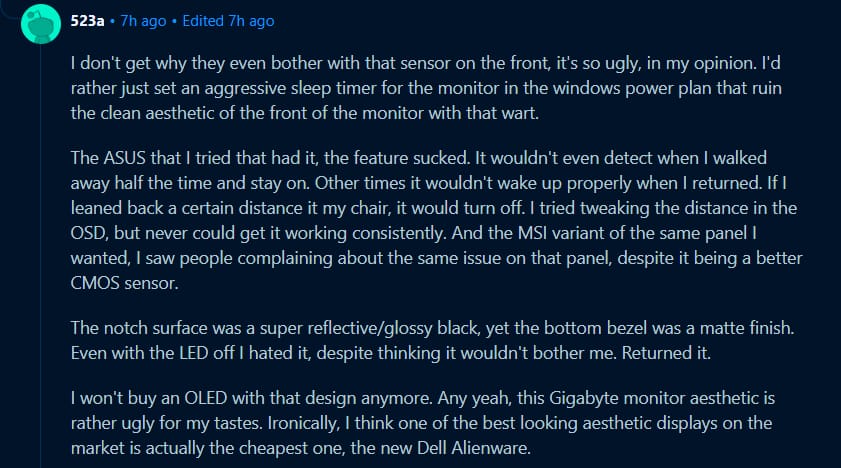 The backlash against front-facing presence sensors also reveals growing skepticism toward over-engineered OLED protection systems. One user described poor reliability with similar implementations on competing OLED monitors and preferred simple software sleep timers over intrusive hardware solutions.
Ironically, that criticism indirectly benefits GIGABYTE’s Mini LED strategy.
The FM275K16P avoids the psychological burden of OLED ownership entirely. No burn-in anxiety. No static desktop stress. No sensor paranoia. Yet it still delivers extremely high HDR performance and refresh-rate flexibility. That may end up being the lineup’s biggest advantage over time.
What This Means for Buyers
The AW3225QF is still one of the best pure gaming displays available if immersion is the priority. The QD-OLED panel, curved geometry, Dolby Vision support, and color luminance create a genuinely premium entertainment experience. But it is also a monitor that asks users to adapt to it.
You need controlled lighting conditions. You need to understand HDR modes. You need to accept the curve. You need to live within OLED ownership constraints.
The AORUS ELITE lineup feels more forgiving. The Multi-Mode architecture makes a single display useful across wildly different workloads. The Mini LED option removes burn-in anxiety entirely. DisplayPort 2.1 support positions the lineup better for future GPUs. AI-assisted processing introduces a new kind of long-term display adaptability.
Most importantly, GIGABYTE is not asking buyers to choose between competitive gaming, productivity, and longevity anymore. That changes the buying conversation completely.
Other Keytakeaways
One of the smartest decisions in the AORUS lineup is actually the cost-splitting strategy between UHBR20 and non-UHBR20 models. GIGABYTE realized most current GPU owners cannot fully utilize 80Gbps bandwidth yet, so it separated future-proofing from core panel quality instead of locking both behind one expensive flagship.
Alienware’s strongest hidden advantage remains Dell’s support infrastructure. The advanced exchange warranty and burn-in coverage are still among the most consumer-friendly OLED support systems available, especially in markets like India where the monitor undercuts major ASUS OLED competitors by massive margins.
The upcoming RTX 50-series rollout will likely determine whether DisplayPort 2.1 future-proofing becomes a genuine long-term advantage or simply an enthusiast specification race.
