

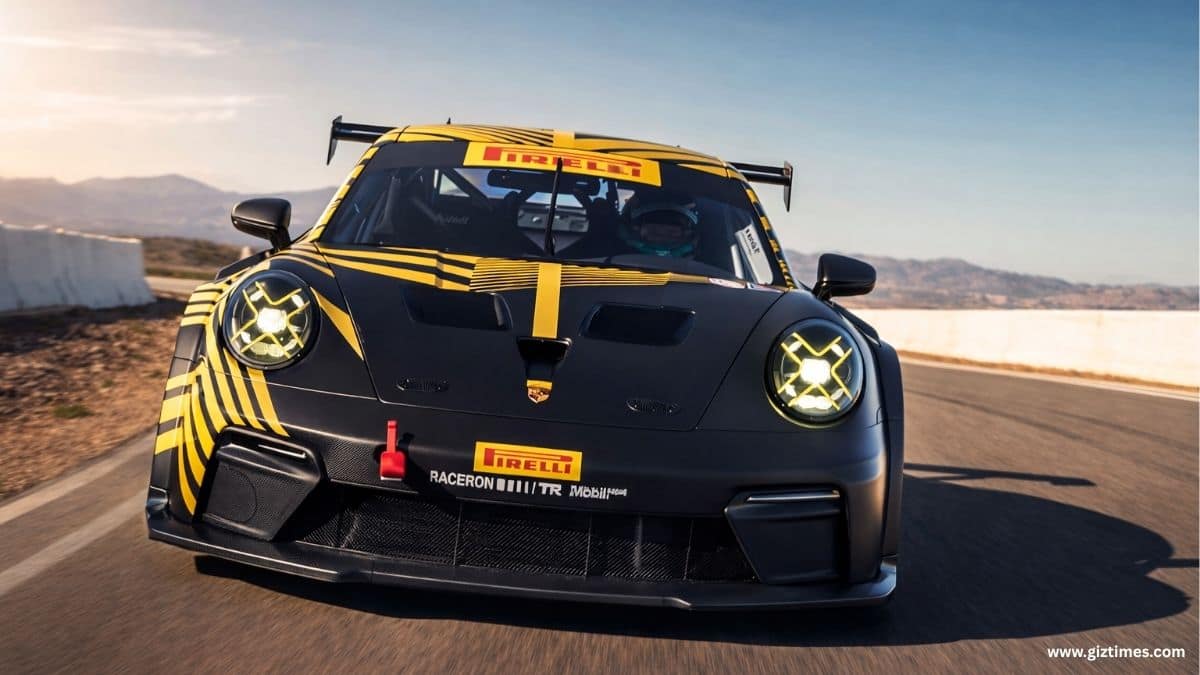
HYDERABAD, India (GizTimes) — The latest version of the Porsche 911 Cup has been tested on track, continuing its role as a key entry point into professional racing; the new model stands out by improving performance while also making the car easier and cheaper to run for drivers.
Porsche as a dedicated race car, the 911 Cup uses a modified 4.0-litre flat-six engine producing 512 horsepower and revving up to 8,750 rpm. Power is sent through a six-speed sequential gearbox, delivering fast and harsh gear changes that are very different from road cars. The car is also around 200 pounds lighter than the standard GT3, which helps improve handling and responsiveness on track.
Driving feel remains the main focus. The steering is light but very precise, and the suspension is stiff to keep the car stable during quick direction changes. Braking performance is also much stronger than a road car, with a firm pedal designed purely for racing conditions. These changes make the car more demanding but also more rewarding for drivers looking to improve their skills.
Porsche has also made practical updates to reduce costs and simplify use. A new control system allows drivers to adjust settings directly from inside the car, without needing external tools. Some parts, like the front splitter, are now easier and cheaper to replace after minor damage. The car also requires less frequent major servicing, which lowers long-term running costs for private racers.
Inside the cabin is stripped down to the basics. It includes a roll cage, racing seat, harness, and a steering wheel packed with controls. Comfort features are minimal, though air-conditioning is now included for certain markets. Everything is designed to keep the driver focused on performance rather than convenience.
The 911 Cup is priced at around $375,000 and can be used in several racing series, including Porsche’s Carrera Cup and Sprint Challenge events. Compared to full GT3 race cars, it offers a more accessible way to enter competitive motorsport while still delivering a serious track experienced matters because motorsport is becoming more expensive and complex, making it harder for new drivers to enter. By reducing costs and simplifying systems, Porsche is trying to keep racing more open to private drivers. At the same time, the car still demands skill, which helps maintain the competitive nature of these racing series.
Public reaction has been mostly positive, especially around safety and driving experience. One user noted, “911 cup cars are pretty well built… drivers just pop out fine for the most part,” highlighting confidence in the car’s safety despite its performance. This reflects a broader trend where enthusiasts value both safety improvements and raw driving feel, especially as modern race cars become more advanced.

Some also pointed out the unpredictable nature of Cup racing, saying it mixes skilled drivers with less experienced ones, which adds to the excitement but also raises concerns about on-track behavior.


The upcoming racing season will likely determine whether this balance between performance, cost, and accessibility succeeds or fails.
Read More:
- Ubisoft Launches Centralized Hub for Rainbow Six Esports, Opening Doors for Tier 2 and Tier 3 Teams
- Samsung quietly increased the prices of the Galaxy Z Fold 7 and Z Flip 7 in South Korea, with higher storage versions becoming more expensive
- 2027 Kia Seltos Gets Bigger, Smarter and Adds Hybrid for the First Time
