

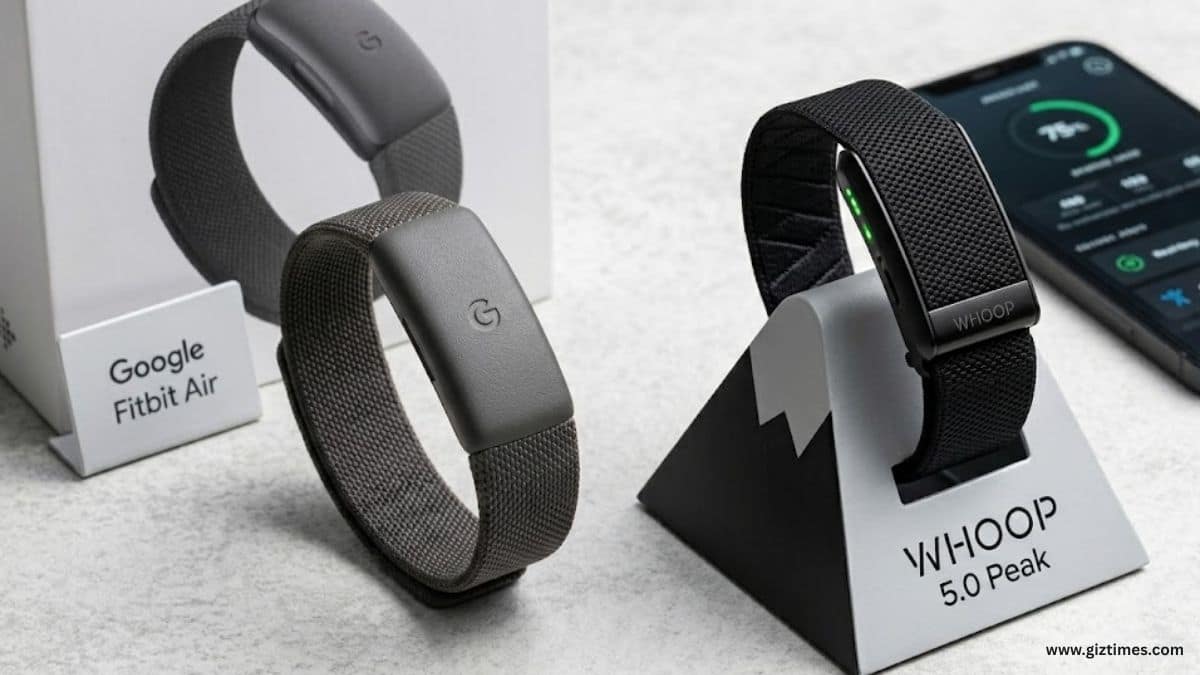
HYDERABAD, India (GizTimes) —The screenless fitness tracker market has quietly become one of the most expensive corners of consumer tech. Not because the hardware is costly, but because companies increasingly monetize access to your own health data. That is why the launch of the Fitbit Air matters far beyond its tiny pebble-shaped design. At $99.99, Google is not simply launching another minimalist wearable. It challenges the idea that advanced recovery insights require a permanent subscription commitment.
WHOOP spent years defining the “serious athlete” category with high-frequency biometric tracking, recovery analytics, and AI-assisted coaching. But the Fitbit Air changes the conversation by separating core health tracking from mandatory recurring fees. Instead of locking basic metrics behind a membership wall, Google positions subscriptions as optional enhancements tied to Gemini-powered coaching. That difference fundamentally changes the total cost of ownership.
The result is not a direct spec war. It is a philosophical split between two business models: one built around continuous subscription dependency, and another designed to pull users into a broader AI health ecosystem at a much lower long-term cost.
Why This Product Exists
The Fitbit Air exists because Google understands a growing frustration with modern wearables: people want health tracking without turning their wrist into another notification screen. The device deliberately removes distractions while keeping passive monitoring active 24/7. That “ambient wellness” approach is the real product here, not the hardware itself.
Google also appears to recognize a larger market opportunity that WHOOP never fully targeted. WHOOP’s ecosystem is optimized for athletes, biohackers, and highly engaged fitness users willing to pay ongoing fees for deep analytics. Fitbit Air instead targets people who want meaningful health insights with minimal friction. That distinction changes almost every hardware decision.
The Fitbit Air weighs just 12 grams with its band and prioritizes comfort during sleep and all-day wear. Google removed the display entirely to extend battery life and reduce maintenance anxiety. Even the charging strategy reflects this thinking. A five-minute charge delivers roughly one day of battery life, reducing the chance users will stop wearing it during critical tracking periods like sleep.
WHOOP takes the opposite route. Its 26 Hz sensor sampling system, bioimpedance-assisted HRV tracking, and multi-modal biometric fusion engine are clearly designed for data fidelity first. The hardware exists to maximize physiological precision, even if it requires a subscription model to sustain the platform’s computational infrastructure.
That creates the central tension between these devices. Fitbit Air is trying to normalize advanced health tracking for mainstream users. WHOOP is trying to professionalize it.
Processor Longevity and Update Roadmap
The processor and AI architecture differences between these products reveal their long-term strategy more clearly than the sensors themselves.
WHOOP 5.0 Peak is built around raw data density. It’s 26 Hz heart-rate sampling captures 26 data points every second, dramatically increasing HRV precision and recovery analysis accuracy compared to Fitbit Air’s much lower sampling frequency. That matters for elite athletes doing high-intensity interval training, strength cycles, or endurance optimization, where small physiological fluctuations influence training decisions.
But high-frequency tracking also creates dependency on WHOOP’s cloud-processing ecosystem. The product’s intelligence largely lives behind the membership layer. Without the subscription, the hardware effectively loses its core purpose.
Fitbit Air takes a more scalable consumer approach. Google is not competing on raw sensor frequency. Instead, it is leveraging Gemini AI integration and ecosystem intelligence to make lower-cost hardware feel smarter over time. The important detail is that Google positions AI coaching as an optional premium layer while keeping fundamental tracking features accessible without mandatory payments.
That changes longevity in practical terms.
A WHOOP user paying $239 annually for Peak membership spends roughly $720 within three years before accessory costs. Fitbit Air users can remain fully functional at the initial $99.99 hardware cost if they choose not to continue Google Health Premium after the included three-month trial.
The non-obvious implication is that Google may actually have more room to improve the product long term because its business model is less dependent on locking users into subscriptions. Since the Fitbit Air acts as a gateway into the wider Google Health ecosystem, Google can justify continuous feature updates as part of ecosystem expansion rather than direct subscription retention. WHOOP, meanwhile, must continually defend the perceived value of its monthly fees.
That creates a subtle pressure difference. Fitbit Air needs to stay useful. WHOOP needs to stay indispensable.
The update roadmap reinforces this divide. Google is actively consolidating Fitbit into the Google Health ecosystem, rebranding the app and integrating Gemini-powered coaching into a unified platform. The strategy suggests long-term expansion of AI across devices and services.
WHOOP’s roadmap is more vertically focused. Features like Healthspan metrics, clinician integrations, and conversational health memory deepen the experience for existing subscribers, but they also increase ecosystem lock-in.
For mainstream consumers, that distinction matters more than sensor superiority.
Comparison
The Fitbit Air and WHOOP 5.0 Peak target similar goals through completely different cost structures and performance priorities. One minimizes ownership friction. The other maximizes physiological precision.
| Feature | Fitbit Air | WHOOP 5.0 Peak |
|---|---|---|
| Hardware Price | $99.99 one-time | Included with membership |
| Subscription Requirement | Optional | Mandatory |
| Annual Cost | Optional $9.99/month for Premium | $239/year |
| Battery Life | Up to 7 days | 14+ days |
| Charging Style | Magnetic USB-C dock | Wearable PowerPack charging |
| Heart Rhythm Alerts | Yes (AFib) | No |
| Sampling Frequency | ~0.5 Hz referenced | 26 Hz |
| GPS | No | No onboard GPS mentioned |
| Notifications | No | No screen-based notifications |
| AI Coaching | Gemini-powered Google Health Coach | WHOOP AI |
| Sleep Tracking | ML-enhanced sleep analysis | PSG-validated sleep architecture |
| Water Resistance | 5 ATM | 10 ATM |
| Target Audience | Mainstream wellness users | Athletes and performance users |
Public Reaction Analysis
The early public reaction exposes the exact divide Google is betting on.
Supporters of the Fitbit Air consistently frame the lack of a screen as a strength rather than a missing feature. One user specifically describes screenless design as “less problem,” associating it with durability, lower distraction, and reduced maintenance anxiety. Battery longevity also emerges as an emotional value point, not just a technical one. The user describing 11-day endurance on an older Fitbit model is really talking about cognitive simplicity, fewer charging cycles, fewer interruptions, fewer things to manage.
That is important because it reveals Fitbit’s actual competitive edge. It is not elite athletic tracking. It is reducing wearable fatigue.
Critics, however, focus heavily on feature subtraction. The second reaction directly compares the Fitbit Air against the older Inspire 3 and questions why the newer device removes notifications, GPS, and some tracking functions while increasing reliance on Google Health Premium. That criticism is valid because the Fitbit Air does sacrifice conventional smartwatch utility.
But the criticism also accidentally proves Google’s positioning strategy. People evaluating the Fitbit Air through a smartwatch lens see missing features. People evaluating it as an invisible health monitor see reduced friction.
WHOOP largely avoids this debate because consumers already understand it as specialized equipment. Fitbit Air creates confusion precisely because it sits between a wellness accessory and a fitness tracker.
Why It Matters
The Fitbit Air matters because it could normalize a new category of affordable AI-assisted wellness devices without forcing users into recurring subscription dependency.
That changes buying psychology.
For years, high-end recovery tracking carried an implicit assumption: better insights require ongoing payments. WHOOP successfully built an entire premium fitness identity around that model. Fitbit Air challenges the sustainability of that assumption by delivering many of the same consumer-facing concepts, readiness scores, HRV analysis, recovery trends, and AI coaching at a dramatically lower long-term cost.
The broader market implication is even bigger. If Google succeeds, subscription-heavy wearable ecosystems may face increasing pressure to justify recurring fees with genuinely exclusive capabilities instead of basic data access.
That does not mean WHOOP becomes obsolete. Its superior sensor fidelity, clinical integrations, and advanced recovery modeling still position it closer to professional performance infrastructure.
But most consumers are not training for elite athletic optimization. They are trying to sleep better, recover better, and stay healthier without spending hundreds annually on a wrist strap.
Other Takeaways
The Fitbit Air’s removable pebble design may ultimately become more important than its current feature set. The architecture hints at future integrations into clothing, clips, or alternate wear positions that could expand passive tracking beyond traditional wristbands.
WHOOP’s strongest long-term advantage is not actually the hardware. It is its clinical direction. Features like EHR syncing and clinician-integrated consultations push the platform closer to preventive healthcare infrastructure rather than consumer fitness technology.
Both companies are moving toward AI-driven health ecosystems. They are simply targeting different economic classes of users while doing it.
The upcoming expansion of Google Health’s Gemini-powered coaching ecosystem will likely determine whether affordable AI wellness tracking truly disrupts the subscription-first performance wearable market.
