Close Menu
GizTimes
    Facebook X (Twitter) Instagram
    Facebook X (Twitter) Instagram
    GizTimesGizTimes
    Source on Google
    • Home
    • Tech News
    • AI
    • Gadgets
    • Cybersecurity
    • Auto
    • Cars
    • Games
    GizTimes
    Home » Samsung’s $1,599 R85H Introduces Micro RGB But Is the Tech Too Advanced for Today?
    Gadgets

    Samsung’s $1,599 R85H Introduces Micro RGB But Is the Tech Too Advanced for Today?

    Yuvraj TiwariBy Yuvraj TiwariApril 15, 2026Updated:April 15, 2026No Comments5 Mins Read
    Facebook Twitter Pinterest Telegram LinkedIn Tumblr WhatsApp Email
    Samsung’s $1,599 R85H Introduces Micro RGB But Is the Tech Too Advanced for Today?
    Samsung’s $1,599 R85H Introduces Micro RGB But Is the Tech Too Advanced for Today?
    Share
    Facebook Twitter LinkedIn Pinterest Telegram Email

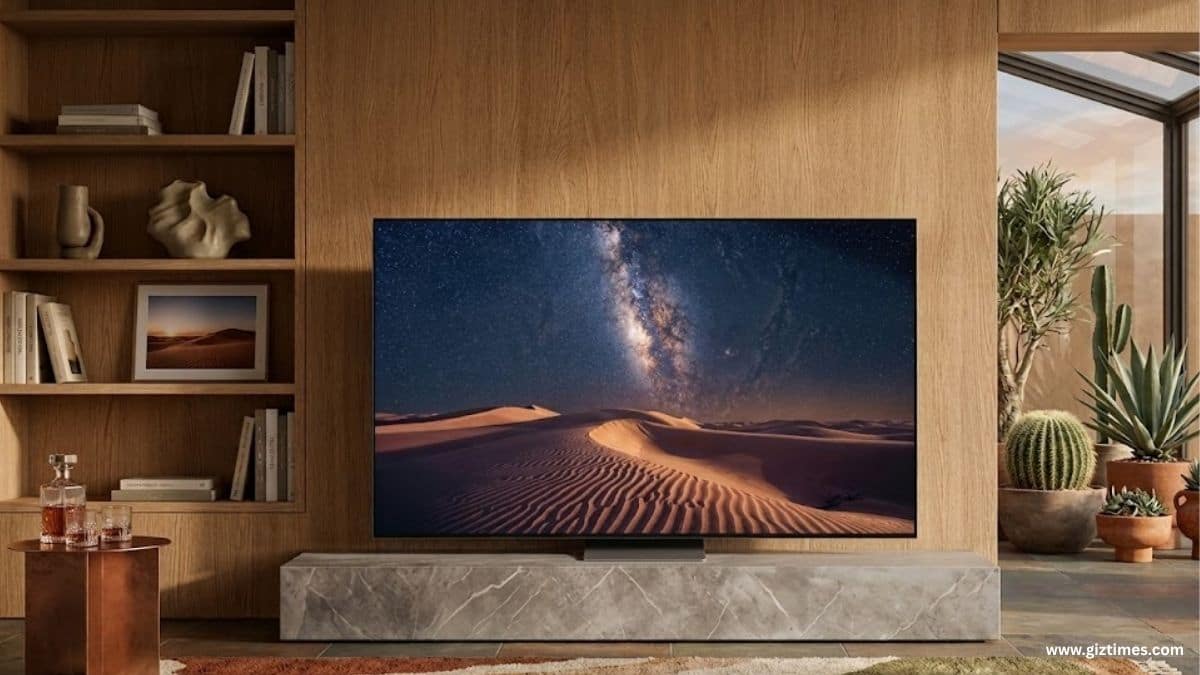
    HYDERABAD, India (GizTimes) —The Samsung R85H, launching in 2026 at $1,599, isn’t just another step forward in TV tech; it signals a shift in what manufacturers are actually optimizing for. Instead of chasing brighter highlights or deeper contrast, the focus here is on precision that arguably goes beyond what most content and even human vision can fully take advantage of.

    That changes how it compares to the Samsung S90F. This isn’t just a future vs. present value debate anymore. It raises a bigger question: what happens when display technology starts exceeding both the limits of available content and what our eyes can realistically perceive?

    Why This Product Exists

    The R85H exists because Samsung is aiming for a new kind of ceiling, one defined less by visible improvements and more by technical perfection.

    With Micro RGB, each pixel produces its own red, green, and blue light independently. There’s no need for conversion layers like those used in QD-OLED, which allows for tighter color control and removes inefficiencies like filtering or quantum dot conversion.

    On paper, that leads to 100% BT.2020 color coverage. Compared to the S90F’s roughly 89%, it sounds like a major leap. In practice, though, the difference is much harder to notice.

    Moving from ~89% to 100% pushes into territory where most people won’t see a clear improvement, especially in typical viewing conditions. At that point, you’re dealing with diminishing returns. The R85H isn’t really fixing a visible issue; it’s solving for theoretical perfection, whether or not viewers or content can actually make use of it.

    Update Roadmap + Display Longevity

    Both the R85H and S90F benefit from Samsung’s commitment to seven years of OS updates, which helps stabilize their long-term software value.

    The real difference shows up in how the hardware behaves over time. The S90F’s QD-OLED panel offers excellent contrast and responsiveness, but because it uses organic materials, there’s still some long-term variability, including potential burn-in under certain conditions.

    Micro RGB avoids that entirely. It’s inorganic LEDs age more evenly, which changes the ownership experience in a subtle but meaningful way. You don’t really have to think about panel management.

    The bigger limitation, though, comes from outside the TV itself: content. Most streaming media is still mastered in the DCI-P3 color space, not BT.2020. So, a lot of the R85H’s capabilities go unused. In a sense, the roles flip. The S90F is constrained by hardware but aligned with today’s content, while the R85H has the hardware headroom but lacks content that can fully utilize it.

    Comparison

    This comparison is less about superiority and more about alignment with human perception, content standards, and usage patterns.

    Aspect R85H (Micro RGB) S90F (QD-OLED)
    Color Gamut 100% BT.2020 ~89% BT.2020
    Perceptual Impact Marginal beyond threshold Already near the human-visible limit
    Contrast High (self-emissive RGB LEDs) Infinite contrast
    Refresh Rate 144Hz 144Hz
    Processor Micro RGB AI Engine Pro (2026) NQ4 AI Gen3 (128 neural networks)
    Burn-in Risk Minimal Present
    OS Updates 7 years 7 years
    Market Position Forward-looking entry point Mature, optimized value

    The S90F is tuned for today’s reality. The R85H is engineered for a theoretical maximum.

    Public Reaction Analysis

    User reactions highlight a gap between technical progress and consumer understanding.

    There’s a fair amount of confusion around what Micro RGB actually is; some people mix it up with Mini LED, while others compare it to high-end MicroLED. That lack of clarity makes the innovation feel less impactful than it might actually be.
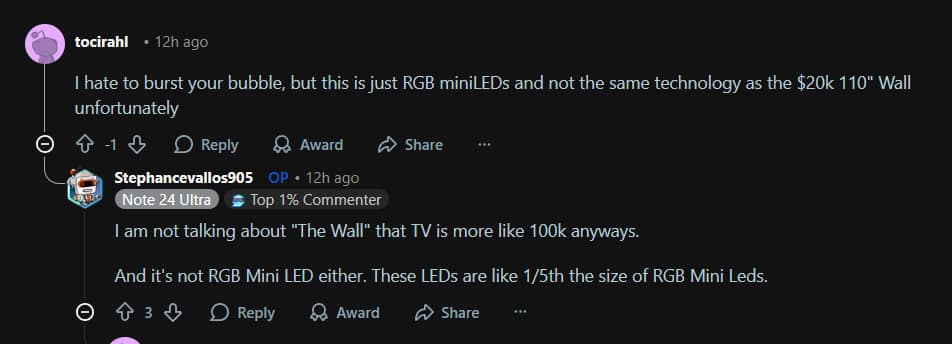
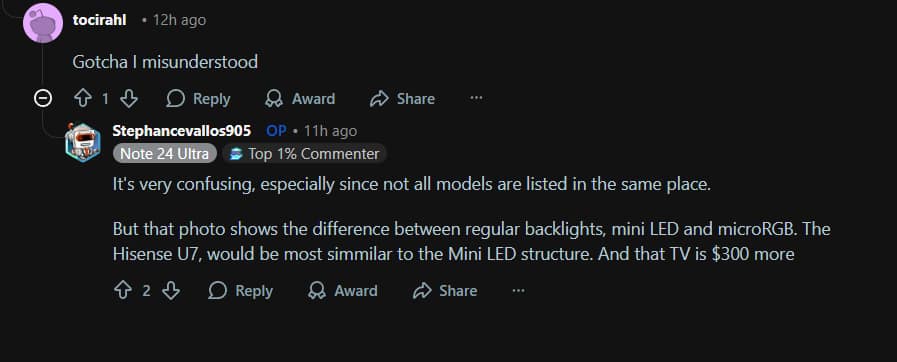
    More notably, people question whether the added precision translates into a noticeably better experience. And that skepticism isn’t misplaced. Once improvements move beyond what’s easily visible, consumers tend to stop valuing them; they prioritize what they can clearly see over what specs suggest.

    Why It Matters

    The R85H introduces a different kind of buying decision.

    It’s not just about picking between two TVs; it’s about choosing between two definitions of value. The S90F focuses on what matters right now: excellent contrast, color that already feels complete, and processing tuned for today’s content.

    The R85H leans into what might matter later: near-perfect color accuracy and long-term panel consistency. That makes the decision less about immediate visual impact and more about how you expect the technology landscape to evolve, which is a harder thing to justify purely on price.

    Other Takeaways

    Display tech seems to be entering a phase where improvements are less obvious.

    In the past, upgrades were easy to spot: higher resolution, brighter HDR, better contrast. Now, many of the advances are subtle unless you know exactly what to look for.

    Micro RGB fits into that shift. It’s less about making images look dramatically different and more about eliminating edge-case issues like burn-in, color inaccuracies at extreme ranges, and long-term degradation.

    At the same time, content hasn’t caught up. As long as most media sticks to DCI-P3, a chunk of what Micro RGB can do remains underutilized.

    Ultimately, real-world reviews and the pace of change in content standards will determine whether Micro RGB’s push beyond perceptual limits becomes genuinely valuable—or remains an impressive but largely untapped capability.

    Read More:

    • Necrophosis: Full Consciousness Is Doubling Down on Horror, But Removing What Kept Scorn Playable
    • OpenAI–AWS Partnership’s 2GW Pact: Why AI Competition Is No Longer About Models But Power
    • PS5 Pro Pushes Cyberpunk 2077 to Its Limits, Same Game But Completely Different Feel
    Share. Facebook Twitter Pinterest LinkedIn Tumblr Email
    Yuvraj Tiwari
    • X (Twitter)
    • LinkedIn

    Yuvraj Tiwari is a tech journalist for GizTimes.com and a Master’s student at the University of Hyderabad. With a keen eye for software trends and a love for cutting-edge gadgets, he brings a fresh, analytical perspective to the latest news in the tech industry. Previously he worked for Kirti Kranti News Paper as a writer for 4 years.

    Related Posts

    Sony Destroys LCD Limits with BRAVIA 9 II’s True RGB Backlight But Is the Original Still the Smarter Buy?

    May 28, 2026

    ASUS ROG Zephyrus G14 vs. Razer Blade 14: One is about Utility, the Other about Prestige

    May 28, 2026

    Sony WH-1000XM6 Solves the Biggest Foldable Headphone Problem While Bose QuietComfort Ultra Still Wins on Pure Comfort

    May 27, 2026

    HP ZBook 8 G2a vs Lenovo ThinkPad P14s Gen 5: Why AI-First Workstations Are Replacing Traditional Mobile Powerhouses

    May 25, 2026

    Galaxy Watch8 and Pixel Watch 4 Represent Two Completely Different Futures of Smartwatches

    May 25, 2026

    Silicon Over Style: Why the Cheaper Meta Quest 3 Will Outlast HTC’s VIVE XR Elite

    May 23, 2026
    Leave A Reply Cancel Reply

    Latest Post
    Gadgets

    Sony Destroys LCD Limits with BRAVIA 9 II’s True RGB Backlight But Is the Original Still the Smarter Buy?

    May 28, 2026

    HYDERABAD, India (GizTimes) —Sony’s BRAVIA 9 II is not a normal yearly television upgrade. It…

    Gadgets

    ASUS ROG Zephyrus G14 vs. Razer Blade 14: One is about Utility, the Other about Prestige

    May 28, 2026

    HYDERABAD, India (GizTimes) -14-inch gaming laptops have always existed in trade-offs. Smaller dimensions meant limited…

    AI

    AI Productivity Bubble Brust, How Companies Have Entered an AI Reality Check In 2026

    May 27, 2026

    ANUPPUR, India (GizTimes) — What made the initial enterprise promise of AI so compelling? Deploy…

    Gadgets

    Sony WH-1000XM6 Solves the Biggest Foldable Headphone Problem While Bose QuietComfort Ultra Still Wins on Pure Comfort

    May 27, 2026

    HYDERABAD, India (GizTimes) —Premium noise-canceling headphones have gone beyond being merely sound-good products in the…

    Cars

    Ferrari Luce: Why Ferrari’s First EV Is Chasing Emotion, Not Just Acceleration

    May 26, 2026

    HYDERABAD, India (GizTimes) — The Ferrari Luce is one of the most important vehicles ever launched…

    Cars

    Mercedes-Benz S-Class vs BMW i7 M70: Why Mercedes Still Defines Luxury While BMW Chases Performance

    May 25, 2026

    HYDERABAD, India (GizTimes) —The latest Mercedes-Benz S-Class continues to occupy a unique position in the…

    Gadgets

    HP ZBook 8 G2a vs Lenovo ThinkPad P14s Gen 5: Why AI-First Workstations Are Replacing Traditional Mobile Powerhouses

    May 25, 2026

    HYDERABAD, India (GizTimes) —Mobile workstations used to follow a simple formula: bigger chassis, louder cooling,…

    Games

    Unreal Engine 6 at Rocket League RLCS: Everything Announced, Why Epic Skipped UE5, and the Hardware Arms Race Ahead

    May 25, 2026

    ANUPPUR, India (GizTimes) — Epic Games did not announce Unreal Engine 6 at a developer…

    Gadgets

    Galaxy Watch8 and Pixel Watch 4 Represent Two Completely Different Futures of Smartwatches

    May 25, 2026

    HYDERABAD, India (GizTimes) —The modern smartwatch market has quietly split into two completely different categories.…

    Cars

    BMW M440i vs Porsche 911 Carrera Cabriolet: Why BMW’s Formula Targets a Wider Performance Audience

    May 24, 2026

    HYDERABAD, India (GizTimes) — Performance convertibles often force buyers to choose between everyday usability and…

    GizTimes

    Giztimes is a technology information site that covers tech-related news and specs, but it also concentrates on conveying the impact that technological breakthroughs have on people’s lives. We provide our readers with comprehensive, data-based, and hand-picked information about the latest trends and innovations in the field of artificial intelligence, cybersecurity, gadgets, automobiles, gaming, consumer tech, and digital technology in general. Our goal is to publish high-caliber analytics that will be of use to professionals and regular readers alike.

    Pages
    • Home
    • About Us
    • Contact Us
    • Disclaimer
    • Editorial Ethics
    • Ethics & Standards
    • Our Team
    • Ownership & Funding Disclosure
    • Publication Description
    • Publisher & Founder Profile
    Policy Pages
    • Corrections Policy
    • Community Guidelines
    • DMCA Copyright Policy
    • Diversity & Inclusion Policy
    • Editorial Policy
    • Fact-Checking Policy
    • Privacy Policy
    • Terms and Conditions
    Facebook X (Twitter) Instagram YouTube LinkedIn WhatsApp Telegram RSS
    © 2026 GizTimes. All Rights Reserved

    Type above and press Enter to search. Press Esc to cancel.