

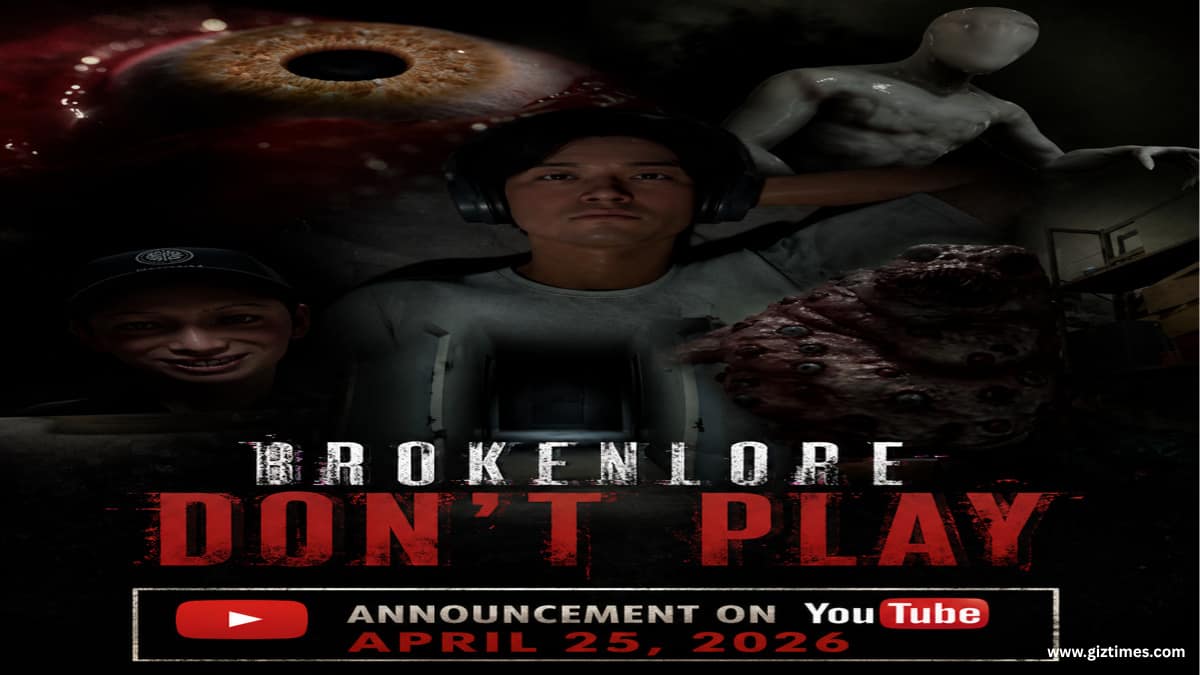
HYDERABAD, India (GizTimes) —BrokenLore: DON’T PLAY was officially revealed on April 25, 2026 through an announcement trailer on YouTube that leans heavily into atmosphere and distortion rather than traditional gameplay clarity. Developed by Serafini Productions, the game positions itself as a first-person psychological horror experience where the act of playing directly corrupts reality.
This isn’t just another entry in the BrokenLore anthology. The trailer suggests a shift toward meta-horror systems that blur player interaction with in-world consequences. That ambition creates a clear tension: the series is evolving creatively, but the technical and performance demands are also scaling in ways that could define its market position.
Why This Matters in Gameplay
At a mechanical level, DON’T PLAY builds its entire gameplay loop around a feedback system where in-game actions reshape the “real-world” apartment. Every completed level doesn’t just progress the story, it destabilizes the environment the player returns to.
That changes how players engage with horror pacing. Traditional safe zones are no longer reliable. The apartment, which would normally act as a psychological reset space, becomes progressively hostile. From a gameplay systems perspective, this removes downtime and replaces it with sustained tension.
The five-level structure reinforces this. Each level introduces new mechanics and rules, but the real pressure comes from the aftermath. Performance here isn’t just about frame rates, it’s about how seamlessly the game can transition between reality layers without breaking immersion. If those transitions stutter, lag, or feel artificial, the entire psychological loop collapses.
Performance Analysis (Framework Integration)
The available technical data gives us a baseline expectation rather than confirmed real-world performance. Minimum PC requirements (GTX 1070 / RX 5700, 8 GB RAM) suggest the game is targeting a mid-tier entry point, while Recommended specs (RTX 2070 / RX 6700 XT, 16 GB RAM) indicate a heavier reliance on visual fidelity and environmental complexity.
This aligns with what the trailer shows: hyper-realistic visuals combined with distortion effects and real-time environmental transformation.
The key performance challenge isn’t raw rendering rather it’s system consistency across transitions. The game constantly shifts between:
- Stable apartment environments
- Distorted reality states
- In-game horror sequences
That means asset streaming, lighting changes, and environmental state updates are happening frequently. Without optimization, this can lead to uneven performance spikes rather than steady degradation.
On consoles like PlayStation 5 and Xbox Series, the fixed hardware helps, but it also raises expectations. Players expect smooth, uninterrupted immersion in first-person horror. Any inconsistency becomes more noticeable because the gameplay relies on psychological continuity rather than action distraction.
A critical unknown here is how aggressive the game’s real-time transformations are. The data confirms dynamic environment changes, but not their frequency or scale. That missing detail is important because it directly impacts performance stability.
Comparison
The BrokenLore series has consistently evolved in structure and mechanics, but DON’T PLAY represents a conceptual leap rather than an incremental upgrade.
| Game Title | Core Theme | Gameplay Style | Mechanical Focus | Narrative Role |
|---|---|---|---|---|
| BrokenLore: LOW | Folklore & curses | Exploration-heavy | Environmental symbolism | Establishes lore foundation |
| BrokenLore: DON’T WATCH | Isolation & surveillance | First-person | Desktop interface mechanics | Defines series identity |
| BrokenLore: DON’T LIE | Truth vs perception | Narrative-driven | Psychological distortion | Expands universe depth |
| BrokenLore: UNFOLLOW | Social media trauma | Survival horror hybrid | Chase + puzzles | Introduces mechanical intensity |
| BrokenLore: ASCEND | Obsession & failure | Vertical traversal | Climbing + stealth | Expands spatial design |
| BrokenLore: DARK DAWN | Abduction & survival | Linear escape | High tension sequences | Adds survival layer |
| BrokenLore: DON’T PLAY | Meta-horror (gaming itself) | First-person | Reality-feedback loop | Most experimental entry |
What stands out is that previous titles experimented with themes and mechanics separately. DON’T PLAY combines them into a unified system where mechanics, narrative, and environment are interdependent.
Public Reaction Analysis
The early community response is fragmented, but revealing.
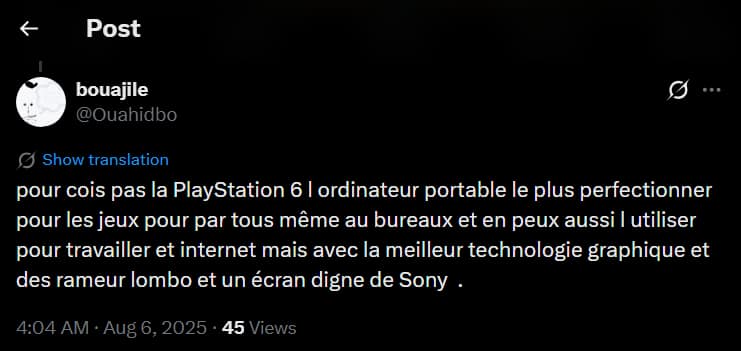
TRANSLATION: Why not the PlayStation 6, the most advanced laptop for games for everyone, even in offices, and you can also use it for work and internet, but with the best graphics technology, lumbar support, and a screen worthy of Sony. (French)
This reaction jokingly references a “PlayStation 6 laptop,” which isn’t about the game itself, it reflects a broader expectation shift. Players are increasingly associating ambitious visuals and concepts with next-gen hardware demands, even when the game is positioned for current platforms. That signals skepticism around whether current-gen systems can fully deliver the intended experience.

TRANSLATION: I used to play Chilla’s Art games a lot, so this seems like it would suit me. (Japanese)
This another comment compares the game to Chilla’s Art titles. This is more grounded and important. It places DON’T PLAY within the indie psychological horror space rather than alongside AAA horror games. That comparison suggests players expect strong atmosphere and concept, but not necessarily technical perfection.
The contradiction here is key. Players expect innovation like a next-gen experience, but evaluate it through the lens of indie horror standards.
Why It Matters
DON’T PLAY sits at a critical intersection for the series. It’s no longer just experimenting with themes, it’s experimenting with player interaction itself.
In the current market, especially within indie horror, the expectation has shifted. Players want:
- Strong conceptual hooks
- Stable performance
- Seamless immersion
The risk is that pushing meta-horror too far without technical consistency creates friction instead of fear. If the system works, it elevates the entire BrokenLore franchise into a standout experimental space. If it doesn’t, it exposes the limits of scaling indie ambition across multiple platforms.
Extra Takeaways
There’s a subtle design pattern across the series. Earlier games externalized fear monsters, environments, folklore. DON’T PLAY internalizes the system itself as the threat.
That shift means performance issues aren’t just technical flaws, they directly undermine the core horror mechanic. Few games tie their concept this tightly to system execution.
If successful, BrokenLore: DON’T PLAY could redefine how gameplay systems generate psychological horror, but inconsistent performance risks breaking the very illusion it depends on.
Read More:
