

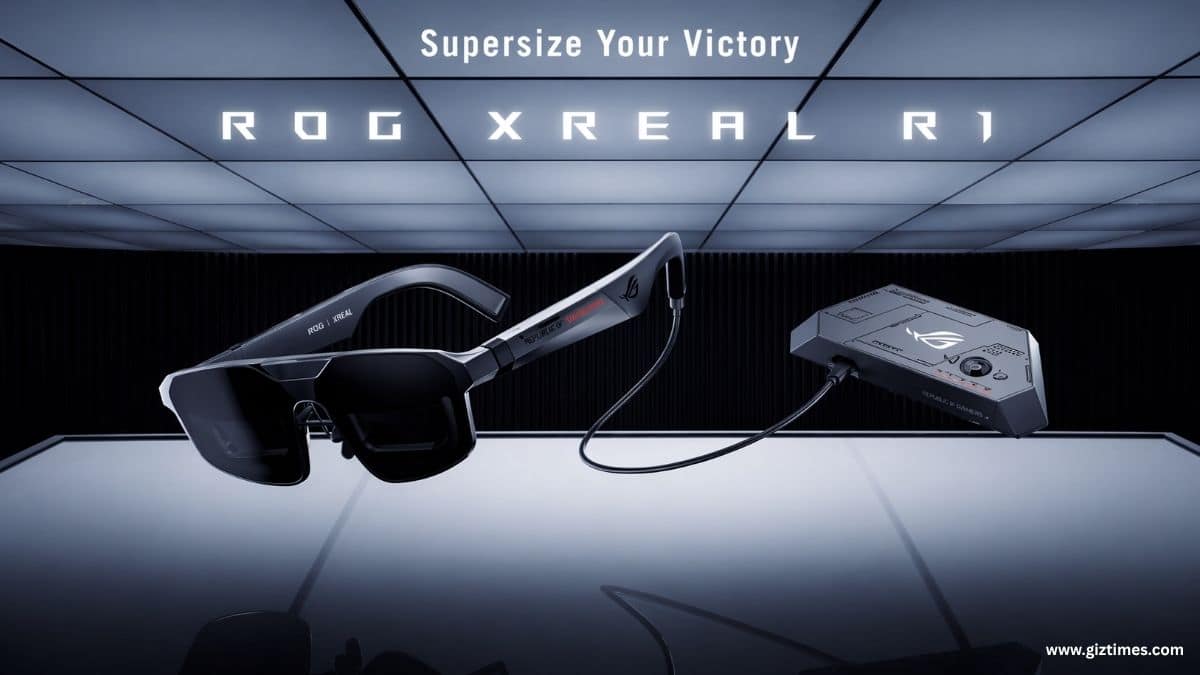
HYDERABAD, India (GizTimes) —AR glasses are no longer progressing along a single, unified path. The arrival of the XREAL One series alongside the ASUS ROG XREAL R1 shows a clear divergence in direction. One is positioning itself as a long-term spatial computing platform, while the other is pushing hardware limits to act as a high-performance gaming display.
On paper, both share similar foundations: Micro-OLED displays, spatial tracking, and USB-C connectivity. The real distinction emerges when you move beyond specs and look at real-world behavior and how each device evolves over time.
Why This Product Exists
The purpose of the ROG XREAL R1 design goes much deeper. The new 240Hz frame rate does not serve as an arbitrary number; its use aims at solving the problem of better motion clarity and response times in high-speed situations.
The transition from 120Hz to 240Hz leads to a reduction in the time needed for generating one frame from approximately 8.3 ms to 4.17 ms. This means that in games where fast motions take place, the blurring of position is reduced. As a result, in some games, the reduction of perceived motion blur is achieved with the help of increasing the speed of frame generation by about 30-40%.
In addition, this change slightly decreases reaction times in cases when the engagement happens during 150-250 ms in shooters. The reaction period decreases by 4 ms, which helps players to notice movements faster and act accordingly in situations that require fast reactions.
The described advantages become evident only in some cases, when the frame rate is high enough, and fast motions occur in the game.
Another case, the series of XREAL One devices, uses a completely different approach to improving the experience for gamers. In this case, the main goal was not achieving maximum performance, but making the image more stable and independent of any external devices. This is ensured by the integration of the X1 spatial computing chip in the glasses.
In this case, the difference in terms of experience is rather subtle and cannot be compared with the previous example.
Quantifying Performance Impact
The gap between 120Hz and 240Hz only matters within certain usage ranges. Below 90 fps, the difference is effectively negligible, the display isn’t fully utilized, and motion clarity is limited by the source. Between 120 and 180 fps, improvements become noticeable. Motion looks smoother, and transitions feel more controlled, but the gains are incremental.
Beyond 200 fps, the advantage becomes clear. Motion blur drops significantly, and tracking fast-moving objects becomes easier. This is where the R1’s hardware starts to justify itself, especially in competitive scenarios.
For example, during fast lateral movement in a shooter, a 120Hz display updates every ~8 ms, creating a broader motion path. At 240Hz, updates happen twice as often, narrowing that path and making it easier to visually lock onto targets during rapid direction changes.
The R1 only delivers meaningful benefits in high-FPS, high-motion environments. Outside of that, the difference exists but isn’t decisive.
Update Roadmap and Ecosystem Longevity
How these devices evolve after purchase is where the long-term difference becomes obvious. The XREAL One ecosystem follows a feature-expansion model. New capabilities like 3D upconversion, SDK improvements, and accessory support are added through software and modular upgrades. This creates a compounding value effect. A device that starts as a media viewer can grow into a productivity or spatial computing tool. Its role isn’t fixed; it expands over time.
The ROG XREAL R1 follows a performance-optimization model. Updates focus on refining firmware and maintaining high refresh rates through tighter integration with the ROG ecosystem. This leads to a narrower evolution path. The device improves at its core function but doesn’t significantly broaden its use cases.
As a result, their lifecycles diverge. The XREAL One is positioned to stay relevant longer, gaining new features over time. The R1 is likely to peak earlier; its value is highest when its performance edge is cutting-edge, but that edge shrinks as competitors catch up.
The R1 behaves like a high-refresh gaming monitor, excellent at one task but limited in scope. The XREAL One behaves more like a smartphone platform, expanding capabilities over time.
Comparison
At a specification level, the differences are clear, but their impact depends on how the device is used.
| Feature | XREAL One Series | ROG XREAL R1 |
|---|---|---|
| Core Positioning | Spatial computing platform | Gaming display peripheral |
| Refresh Rate | Up to 120Hz | 240Hz |
| Latency | ~3ms | 2–3ms |
| Performance Behavior | Consistent across devices | Peaks in high-FPS scenarios |
| Connectivity | Direct USB-C (DP Alt Mode) | Dock-dependent optimized pipeline |
| Ecosystem Growth | Software + accessories | Hardware + ecosystem tuning |
| Update Model | Feature expansion | Performance optimization |
The key distinction is not the raw specifications but the conditions under which those specifications translate into meaningful user benefit.
Public Reaction Analysis
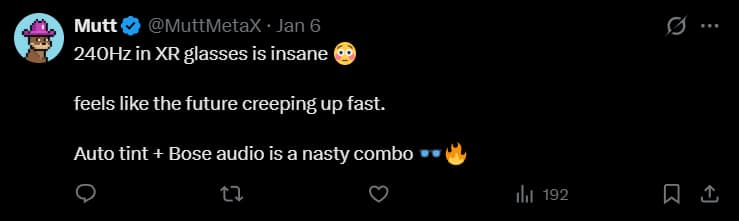
There is an evident duality between reactions of users to immediate improvements and those for future use cases.
The term 240Hz in XR glasses shows that users perceive noticeable improvements in performance through their visual perception, primarily in gaming. The higher refresh rate feature is straightforward and easily associated with improvements in performance.
 On the other hand, the term AR glasses as a second pair of eyes shows that users demand usability and practicality from such gadgets.
It becomes evident that users react differently to performance improvements compared to practicality and usability.
Why It Matters
Ultimately, this comes down to priorities.
The ROG XREAL R1 is best for users consistently operating in high-FPS gaming environments where motion clarity directly impacts results. In those conditions, its advantages are real and measurable.
The XREAL One series is better for users who want a device that evolves. Its value comes from adaptability and long-term utility rather than peak performance.
This isn’t about which device is better overall; it’s about whether you prioritize peak performance in a narrow use case or sustained relevance across many.
Other Takeaways
Together, these devices highlight two directions for AR. The R1 shows that AR can match traditional displays in performance-heavy scenarios. The XREAL One shows that AR can grow into a broader computing platform. These aren’t just different products; they’re different visions of what AR should become.
The future of Android XR and wider software ecosystems will likely determine whether AR leans toward performance-focused hardware or platform-driven spatial computing.
Read More:
- Google Gemma-4-31B-it Emerged as the Research Co-Pilot: Alternative to ChatGPT and Gemini For PG and PhD Students
- When Performance Stops Being Premium: Can OnePlus Pad 4 Challenge Samsung’s Ultra Experience?
- Valve’s 2026 Steam Machine with Better Optimized Software, How will it be Better than PS5 and Xbox?
