

HYDERABAD, India (GizTimes) —Valve has released its Steam Link beta app for the Apple Vision Pro, marking the beginning of game streaming in the nascent spatial computing and mixed reality space. Available for installation through TestFlight, the application is a significant leap forward in that it shows Apple’s new device is much more open to games than previously thought possible and capable of offering a great gaming experience despite the steep price point and typically closed-off ecosystem.
With Steam Link, users can play their favorite PC games directly from their gaming PC into the Vision Pro headset by simply mirroring their desktop inside of it with controllers and the familiar Big Picture interface from Valve’s platform. With newer Vision Pro units featuring Apple’s M5 processor, gamers can achieve a 120Hz refresh rate for their stream. The graphics are rendered at up to 3,660 x 3,200 pixels resolution across two micro-OLED panels. In addition to standard controls, Valve’s solution offers eye-tracking and pinch controls, making it possible to use eye movements as a cursor to interact with your mirrored PC desktop.
Even though the app itself provides many useful features, some issues might arise in the process. Using the headset for an extended period of time can make one feel uncomfortable because of its weight. As for the software, users report experiencing UI flickering, latency in controller input when navigating menus, and, most importantly, a bug that forces them to exit the Steam interface completely once they attempt to leave the game.
Considering performance, a good internet connection becomes very important. In order to make sure there is no lag and any visual glitches, users would need to make use of the best possible Wi-Fi connection that they have. Compared to Mac’s native mirror mode, this method fails to provide wide-scale support.
Of course, alternative solutions already exist – for instance, ALVR provides for PCVR streaming but requires a little more effort and technical knowledge. There is also ClearXR, which relies on foveated streaming and Nvidia’s CloudXR SDK. While the technology works well, it currently lacks the ability to support Valve’s SteamVR platform.
Thus, Valve’s solution seems much simpler despite its current limitations. What is also noteworthy is that Apple’s rival is making moves in quite the opposite direction from Meta. While the latter is moving away from gaming on its Quest platform, the former seems ready to embrace it as an integral part of its spatial computing strategy.
It matters because it represents another possibility for premium mixed reality devices. Allowing gamers to easily stream their games to the Vision Pro without creating any additional native applications, Valve makes the new device more attractive to a wider range of people. It is quite obvious that the future will bring much more than 2D streaming if Valve starts implementing VR streaming into its system.
Public reaction on Reddit has been cautiously optimistic, with users viewing the beta as an early step toward deeper integration.
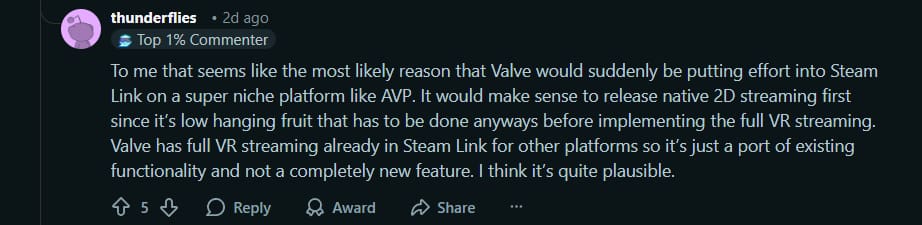
One commenter noted, It would make sense to release native 2D streaming first since it’s low hanging fruit,suggesting that Valve may be laying groundwork for full VR support. This interpretation reflects a broader trend in the industry, where incremental feature rollouts are used to test platforms before committing to more resource-intensive capabilities.
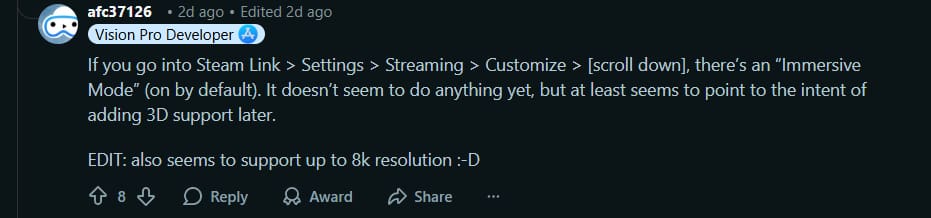
Another observation pointed to a hidden Immersive Mode setting and potential 8K support, reinforcing expectations that more advanced features are already in development.
The upcoming full release or feature expansion will likely determine whether the Vision Pro can evolve into a viable high-end gaming platform.
